For my entire life, I have run hot. So 20 years ago I was an enthusiastic early adopter of breathable wicking athletic apparel made most popular by Nike and their DryFit line. These products made athletic activities like skiing, running and hiking much more pleasant.

Aviator Blue on Left, Baubax Black on Right
For years I have found it puzzling that these technologies are not incorporated into business wear. Especially as work is more mobile and active. Walking Desks, walking meetings, and biking to work are realities for many people. Dashing to make flights or meetings in my cotton and wool clothing is hot and constricting. Showing up to meetings sweating and self conscious, does not present the image anyone wants.
So it is with great delight that these products are starting to come to market. I want this category to succeed but it is worth noting that I bought these products and am not a part of any promotional program.
Baubax Blazer. Born out of a fabulously successful Kickstarter campaign funded by people such as myself, the Baubax blazer is a high quality unit. The material is thick and looks like fine wool or silk. The fit is tight – Trevor Noah suit coat tight. To me it looks like I bought the wrong size. I run between a 44R 46R and the size chart suggested an XL . However it is so tight I strongly considered returning it. It is between a 43R and a 43L, but the material stretches to maybe a 44R. The Baubax arrived in a box very wrinkled. After wearing it twice and hanging it up for 2 weeks, it is still very wrinkled. That is not great for a travel jacket. The Baubax comes with lots of features – too many in my view. Fortunately most are removable. The blazer hood, a ridiculous look even when it was popular, zips out. The hand warmers, which makes putting on the blazer a 45 second frustrating process, button out. It also includes a very nice detachable head pillow which I might use someday, but I doubt it. The Blazer comes with cheap wool-ish gloves, a collapsible water bottle (like what they give out at trade shows) and a little key-chain pen. Not sure why. Sadly, I think everything but the blazer will be in a landfill is a few weeks.


Styling is a very narrow lapel that looks good now, but will be out of style in a few years. That is fine as future iterations will be much better. Baubax has functioning buttons on the front and sewed-on buttons on the sleeves. Side vented in the rear. Fully lined with a nice material. Lots of pockets which was a major selling point for me. Importantly it will hold and iPad Air, which is my preferred device for conferences. Unfortunately, the Baubax is so tight that the pockets are nearly unusable. At $150-$200 depending on when you bought it, it is a great deal.
Ministry of Supply Aviator II is lighter, stretchy, and more of a casual sports jacket. The Aviator would work for business casual, but not for a business dinner at the Four Seasons in a major city. It is a business blazer, but is also has some soft-shell aspects. The material beads rain and the seams are taped. This is the one you want if it rains. The “CobraX” buttons are more functional but less dressy. Importantly these fasteners makes it impossible to alter the Jacket (they are snaps more than buttons). However, it does make the jacket stay shut, which can be great for rain, or moving quickly with a backpack. It is unlined with a rear vent. The side pockets zip shut, but are small. Not sure why you need zips. The inner pockets are few, and only one will hold an iPhone 6 Plus. At $350 it is over-priced.


Comparison. The Baubox is thicker, more dressy, more traditionally styled and looks much more upscale. It warmer, but does not breath as well as the Aviator. It would work for an East Coast trip in the spring/fall. In terms of appearance and functionality it is the Baubax. The Ministry of Supply Aviator is very light weight. It better for the Summer, but could be used year round in warm climates. In terms of flexible and breathable – it is the Aviator no contest. Also you can try on the Aviator is you are in San Francisco or Boston.
I will be keeping them both and look forward to feature versions from these and other suppliers.
I never believed the articles about Facebook not being popular with teenagers until I saw the the sign-up sheets below sitting on our kitchen table.
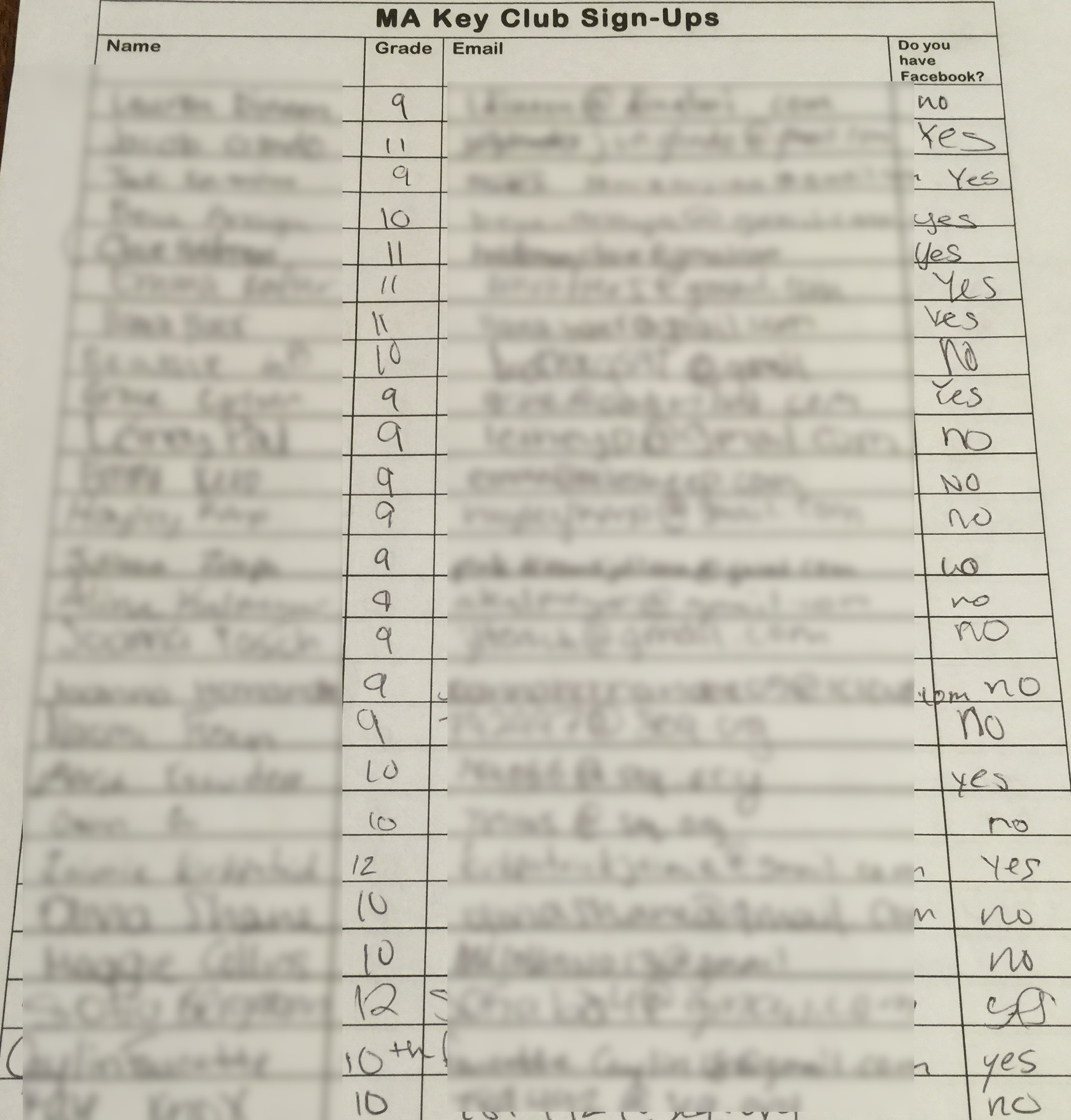
Quick background. One of my daughters is co-president the largest community service club at Menlo-Atherton High School. For the last four years they have used Facebook to organize their events. Last Friday was “Club Rush” where all the clubs put out card tables and interested students sign up for the club. The good news for the community is 76 new students signed up. The bad news for Facebook is only 32 of those (42%) have Facebook. Of the 29 Freshman who signed up only 7 (24%) have Facebook.
Of course it is hard to draw conclusions from such a small data set, but keep in mind that Menlo-Atherton is the closest major high school to the Facebook campus. Facebook even donated their new computer lab. These are among the most technologically sophisticated teenagers in the world.
So how do the children of Silicon Valley want to be contacted? Email.
Cross posted to BehindTheFeeds.
“The whole idea of governments, nations, it’s public relations theory at this point.” Martin Q. Blank, Grosse Pointe Blank
Last night I attended VLAB’s “Virtual Currencies Gold Rush or Fools Gold, the rise of Bitcoin in a Digital Economy” at the ever more swanky Stanford GSB. I have long felt that the next Bill Gates level fortune will come from who every figures out virtual currencies.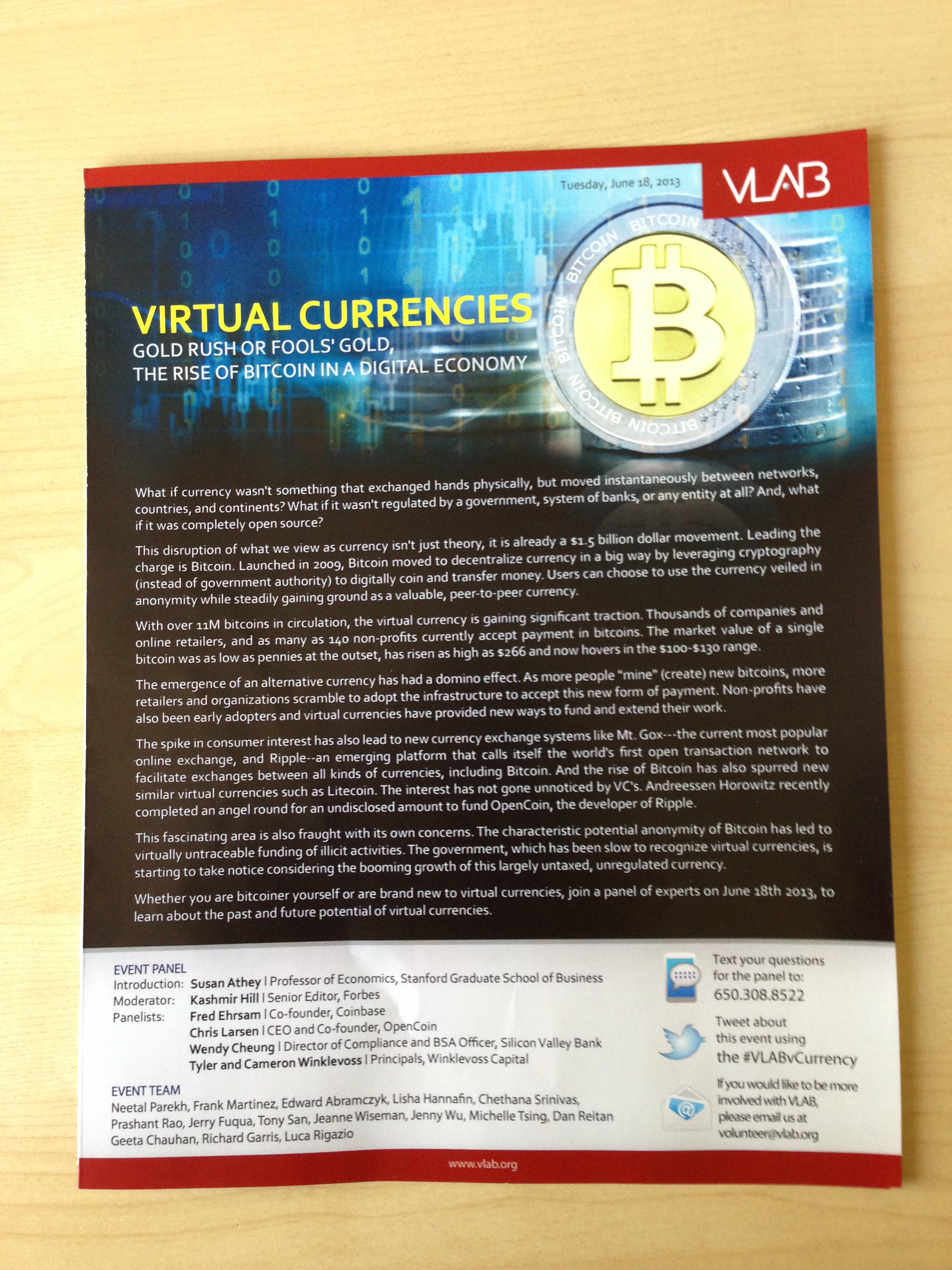
A particularly strong panel included Chris Larson of E-Loan fame, the Winklevoss twins (yes, they both came), Fred Ehrsam who runs the USV-funded Bitcoin exchange Coinbase, Wendy Cheung of SVB with moderation by Forbes’ Kashmir Hill.
The event opened with GSB professor Susan Athey giving an overview of Bitcoin focusing on her belief that the value of Bitcoin is determined by the volume of transactions in the currency. Moderator Kashmir Hill describing her humorous experience trying to live off from Bitcoin for a week. Long story short, she lost 3lbs because she could only eat sushi and cupcakes as only two eateries in San Francisco took Bitcoin. She also had to walk everywhere because taxis and buses do not take Bitcoin.
Next up is Chris Larsen who provide a crisp six slide (Yes, Visuals, Thank You!) overview of the history of math based currencies and his start-up OpenCoin, creator of Ripple, a virtual currency similar to Bitcoin. He noted that Bitcoin rose during the economic meltdown of 2009 when we lost faith in financial institutions and nation-based currencies. He compared the similarities and differences of Ripple and Bitcoin and closed by asking whether virtual currencies would develop the “trust, utility and liquidity” to become “the HTTP of money” or fade away like the Occupy Movement.
The panel moved to Q & A with Ehrsam and Larsen answering question on how virtual currencies actually work – mining, exchanges, etc. Applications were also discussed including micropayments. One of the Winklevoss (who claim to own 1% of all Bitcoins – not sure if they remember the Hunt brothers) suggested “banking the world.” For you celebrity watchers, they came off nothing like the characters in the Social Network. They were very relaxed and affable young men.
I kept thinking about PayPal and was surprised that it was never mentioned as it seems so applicable. For years PayPal literally gave away money trying to get people to pay each other using PayPal (to solve the cupcakes and sushi problem). Ultimately they got adoption by enabling greater efficiency on a platform people use, eBay. Once the got traction, every bureaucrat from every government in the developed world showed up on their doorstep to regulate them. Given the difficult times (July, 2002) their acquisition by eBay was a gold rush. But their upside was limited as there was basically one buyer. It is worth noting that at the time of the acquisition, the consensus of the pundits was that PayPal would ultimately be worth more than eBay. Several years later, that is not the case.
While math-based currencies are still searching for their eBay, exchanging cash instantly across borders with zero transaction costs – that would be an incredible new freedom. On the other hand it would be very disruptive to taxation, capital formation and the financial services industry. One panelist asked “why do we need banks?” My mind moved to the killer quote above. But as Larson noted, “the financial services industry is very hard to disrupt.”
Thanks to our friends at Intel, I maintained a perfect three for three attendance at this the Web 2.0 Summit. It was the perfect venue for our big announcement and it generated terrific publicity. I think this is a watershed moment in bringing Web 2.0 to the enterprise.


This year’s event was different than the previous two versions. While huge (and Tim O’eilly claimed they turned away 5,000 people), the mood is more businesslike. Gone is the “everyone is getting rich but me” frenzy of the second year and the “I’m not the only one who thinks there might be something here” attitude of year one. VC attendance was way down. Corporate business development attendance was way up.
Day three was the most interesting. Below are a few highlights.
Ram Shriram on the current environment “While there is venture money for early stage companies, the number of billion dollar exits are very few and far between. There have been two internet IPOs this year and both are languishing at a sub $500m valuation and suffering from a lack of research coverage.”
Note to all journalists trying to sell more of their publication by saying we are in a bubble. A bubble is when companies with no chance of profits are sold for over a billion dollars or go public on a daily basis. Thus, we are not in a bubble. Clear enough?
More from Ram “There will continue to be many sub $100 million exits, but this is threatening to venture capital IRRs.”
Roger McNamee (whose hair cut shows he is spending too much time with Bono) on content “Media guys say that user generated content is just an appetizer, people really want Hollywood movies. that’s just bullshit.”
McNamee to along winded entrepreneur whining that he could not raise venture capital. “Entrepreneurship is not for lightweights.”
Eric Schmidt flatly denied that any of the uTube consideration was going to copyright holders.
Barry Diller on company building “Equity is built by holding on.”
On the Teen panel (which was not nearly as good this year). Question “ How much time do you spend on MySpace? Unanimous response, “2-4 hours a day” “because I want to get my profile just right” and “I like it when people tell me they love my MySpace page” and “When I check my MySpace page it is like Christmas morning with the presents under the tree.”
Question – Who do you trust more Yahoo or Google? Unanimous response, “Google.” They will regret that.
Best eye candy came from Microsoft labs.
Sunday April 23rd
It took 45 minutes to buy the card. Most of that time was spent answering questions for the Cingular sales person and watching him manually enter the data “data they already have as I am a 15 year Cingular customer. I pass the time by watching people 3 deep buy Razrs.

Captured the card and took it home. After a 5 minute install and I can see the network but it will not connect. Switch to WiFi and get an added bonus – Outlook will not check POP email. Cingular is blocking something. Spent two hours reading through forums and doing an upgrade of the firmware in the card. Same problems.
Monday, April 24th
Took the card and the PC to Cingular. Got laughed at for using the included software -“The Cingular stuff doesn’t work, go download the Watcher utility from the Sierra web site” Did a system restore and installed the Sierra Watcher software. Still can not connect, but can collect POP email. Took it to Cingular again, but the no one in the store knew anything about the card. More people buying Razrs. Another hour trolling through support boards looking for the solution.
Tuesday April 25th
Took it to Cingular again. The manager took one look at my dbase record and sheepishly admitted the clerk had not activated my card. 30 seconds later, it works – really well.
Wednesday and Thursday, April 25 & 26
Never loses connection during 8 straight hours of RSS demos in the bowels of the Moscone. And it’s fast!
Friday April 27
Moving offices on Monday so call SBC/AT&T to makes sure the order for internet service to our new office is on track. It’s not. The rep did not put in the order (nice job, “Gary” of SBC’s Torrance office). Install 3G card on old Vaio and use Windows internet connections sharing out the eithernet adaptor to a router to provide wifi to the new office space. A terrific short term solution, although the engineers complain of slow uploads for doing builds. Probably violating some terms of service, but given the amount of my time they wasted this week, we can call it even.
Saturday May 6
For inexplicable reasons, coach makes my daughter arrive an hour early for her soccer game. Rather than flipping through magazines, I get work done. Nice. No noticeable drain on battery.
Monday May 15
Off to New York for the Syndicate Conference. Works well in San Jose Airport. Arrive at lousy hotel, where the “free” WiFi costs $10 a day. The Cingular sales rep had said that 3G won’t be fully deployed in New York till the end of the year. I fire up the 3G cards and get nothing. Not even Edge. Try it at an agency meeting across town and get nothing. Try it at a partner meeting downtown and get nothing. New York, not a Cingular 3G kind of town.
Conclusion – it’s magic when it works, but Cingular has a long ways to go with thier network and their customer service.
I spent the middle of the week at Red Herring’s CMO Conference where the theme was “Understanding the Technology Customer.” The big themes I heard.
– The rise of the web Larry Webber, the web is not another vehicle, it is the vehicle.
– The Googlification of marketing success is directly tied to how effectively companies turn their customers into their sales force without advertising.
– The emergence of PR as a lead generation tool, which the Salesforce.com CMO called “the virtuous hype circle.”
– CMO Rising CMO moving from a staff role to more central to the success of tech companies
– Use of internet tools (such as email) to achieve near term ROI at the expense of lifetime value of the customer.
The dapper and gracious Alex Vieux wrapped up with his top 10 takeaways from the conference. Number two – Branding is not a marketing issue it is a business issue.
This rang true as I went back to hotel. Lest the entrepreneurial live seem too glamorous, I was again too cheap to stay at the conference hotel, so I stayed at the Holiday Inn Express Encinitas.

Or so I thought, as that very day the hotel had been turned into a Howard Johnson. Neither brand has much of a connotation in my mind. And I don’t spend much time thinking about that which I can not control. Not so their cliental. Checking in at 10:30 PM and checking out at 7AM, I stood in line as guests voiced their anger in person and on the phone. What would this mean to their rooms? What about their reward points? Would their reservation still be valid? Do they still serve breakfast? The patient desk clerks answered the questions and only complained that their new uniforms had not yet arrived. To me it was the same hotel, they just changed the name, but not to their customers. Somewhere the branding team at Holiday Inn is smiling.
The corporate marketing track started off with on a high powered note with Ryan Rosenberg and Marc Landsberg speaking and Chris Kenton moderating. It was that rare panel that you wish would not end. Kenton, a BusinessWeek columnist and head of the CMO Counsel asked excellent questions. Some highlights. 
Rosenberg discussed the creation of podcasts in conjunction with the launch of Filemaker 7. The idea came from the PR team, not a top level corporate mandate. Initially they created scripts but went away from the scripts to keep it more conversational. They also recorded over the phone (rather than go to a studio) to make is sound more live and conversational. In the first 90 days 12,000 people have downloaded the podcast. Given the specificity of the content that seems fantastic. Next will be a series of Podcasts tailored to their vertical markets.
Landsberg discussed big marketing trends “innovation is coming from consumers, not corporations – they own the brands anyway.” He discussed the consumer value exchange equation = consumer give money and attention and get goods or services. New tools such as RSS, Blogs and Podcasts have the ability to effect that equation. He also nicely summarized where the tools fit in the acquisition to retention continuum.
Finally Kenton brought up measurability. Rosenberg felt results came from good content rather than from delivery. Landsberg felt that it is too early to determine ROI on RSS, Blogging and Podcasting initiatives, and that the focus should be on increased brand interaction and on measurables such as click-throughs, registrations and conversions.
Just scratching the surface with the above, I eagerly await the podcast from Chris.
 Drop by the Syndicate Conference next week. We will have a table top and I will be moderating a panel on the branding benefits of RSS.
No word on the jump suit.
If you are in NYC come visit us at ad:tech tomorrow or drop by their web site and see why this guy is so excited. 
I am gazing into the future this week at the steamy Web 2.0 conference. Despite Alan Greenspan rehearsing for his role as McDuff, the mood is very upbeat. A run down of the trends.
Ajax Apps – wow they have gotten good! They have moved beyond responsiveness to include other desktop attributes like support for keyboard shortcuts and file save reminders. They are also taking advantage of the ease of integration of web services making these services “fully-Web 2.0.” Yeah, dude.
A particularly outstanding example is Zimbra. Think Exchange with every conceivable web service hyperlinked/mashed into your email, as bubble help. Dates bring up your calendar, tracking number go check their delivery status, and of course addresses bring up Google maps. If it works, I want it.
Identity/Attention – The Attention Trust demoed their Attention Recorder, a plug in to Firefox that captures your click stream. The hope is that companies build applications that will provide value to end-users in exchange for the stream. SXIP might be on to something by tying identity to a real world problem with sxore, a distributed identity system to combat blog spam.
Investors. The VCs are out in force despite other pressing business in San Francisco this week. While they are aggressively turning over every rock, they are complaining about Web 2.0 companies being undefensible businesses with small market opportunities.
So are we in for Trouble? Tragically, we will have to wait for Web 2.0 Act II.

 Indexed Forever